




Most caregivers assume that buying a GPS watch for a loved one means instant, real-time tracking right out of the box. That assumption can leave families with a false sense of security. The truth is that a GPS chip alone can pinpoint a location, but it cannot send that location anywhere without a cellular connection. A SIM card is what bridges that gap, turning a passive locator into a live safety tool. Understanding this difference is not just technical trivia. For families caring for seniors who live alone, have a fall risk, or show early signs of dementia, it can be the difference between a quick response and a dangerous delay.
Table of Contents
- What does a SIM card do inside a GPS watch?
- SIM cards vs. Bluetooth: Why cellular matters for senior safety
- Real-world safety features unlocked by SIM-enabled GPS watches
- How accurate and reliable are SIM GPS watches?
- Battery life, data usage, and practical tips
- Balancing safety, autonomy, and privacy
- Explore GPS smartwatch options for enhanced senior safety
- Frequently asked questions
Key Takeaways
| Point | Details |
|---|---|
| Real-time location sharing | SIM cards allow GPS watches to instantly transmit seniors’ locations anywhere with cell coverage. |
| Enhanced independence and safety | Cellular GPS watches let seniors move freely while families receive instant alerts and updates. |
| SIM beats Bluetooth range | A SIM-enabled GPS watch works far beyond the short range of Bluetooth trackers, crucial for unsupervised outings. |
| Responsible and ethical use | Consent and privacy controls should always be discussed and enabled when monitoring loved ones. |
What does a SIM card do inside a GPS watch?
Think of a SIM card as a tiny phone plan built directly into the watch. It gives the device its own cellular data connection, completely independent of any smartphone nearby. Without it, a GPS watch can calculate its position using satellites, but that position stays locked inside the device with no way out.
With a SIM card installed, the watch can send live location data directly to a caregiver app, no paired phone required. That means your parent can walk to the corner store, visit a friend, or sit in the garden, and you can check their location from anywhere in the world.
Here is what a SIM card enables inside a GPS watch:
- Live location updates sent to your phone or app
- Two-way calling directly from the watch
- SOS alerts triggered by a button press
- Automatic fall detection notifications
- Geofence alerts when a senior leaves a set area
For a deeper look at how GPS watches compare to phones for senior safety, the differences go further than most people expect.
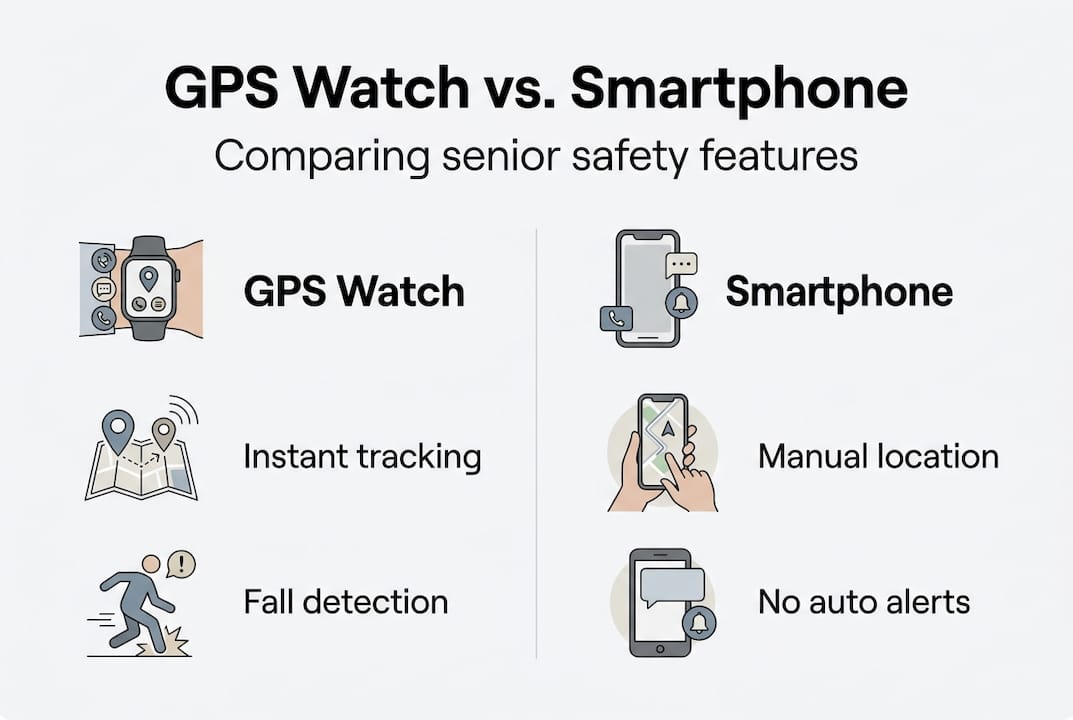
Pro Tip: Choose a SIM plan with enough data for your tracking frequency. Most GPS location updates use very little data, but if you enable live tracking every minute, usage adds up faster than you might think.
SIM cards vs. Bluetooth: Why cellular matters for senior safety
Many entry-level trackers rely on Bluetooth instead of a SIM card. Bluetooth works well when a senior is within a room or two of a paired smartphone, roughly 30 feet in real-world conditions. Step outside that range and the connection drops entirely.
For seniors who stay close to a caregiver at all times, Bluetooth may be adequate. But for anyone who goes on independent walks, visits a park, or has a tendency to wander, Bluetooth simply cannot keep up. SIM GPS watches offer long-range tracking anywhere with cellular coverage, which is a critical advantage for unpredictable situations.
| Feature | Bluetooth tracker | SIM GPS watch |
|---|---|---|
| Range | ~30 feet | Nationwide cellular coverage |
| Requires paired phone | Yes, always | No |
| Works outdoors | Limited | Yes |
| Real-time alerts | No | Yes |
| Two-way calling | No | Yes (on most models) |
| Suitable for dementia risk | No | Yes |
“Bluetooth-only trackers are suitable for short-range, supervised settings. For seniors with unpredictable movement patterns, a SIM-enabled GPS watch is the only reliable option.”
For families exploring the full range of GPS tracker options for seniors, understanding this distinction helps narrow down the right choice quickly.
Real-world safety features unlocked by SIM-enabled GPS watches
A SIM card does not just enable location sharing. It unlocks an entire layer of proactive safety features that passive GPS simply cannot offer. The GPS receiver locates position via satellite, but the SIM-powered cellular modem is what sends that data for live updates, alerts, and geofencing.
Here are the key safety features that become available with a SIM-enabled watch:
- Geofencing: Set a virtual boundary around home or a neighborhood. If your loved one crosses it, you get an instant alert.
- Live tracking: Open the app and see exactly where they are, updated in near real time.
- SOS button: One press sends an emergency alert with location to pre-set contacts.
- Two-way calling: Speak directly through the watch, no phone needed on either end.
- Fall detection: The watch senses a sudden impact and automatically sends an alert.
To get the most out of these features, follow these steps after setup:
- Set up at least two emergency contacts in the app.
- Define a geofence around the senior’s home and regular routes.
- Test the SOS button together so your loved one feels confident using it.
- Enable low-battery alerts so the watch never goes dark unexpectedly.
- Review location history weekly to spot any unusual patterns early.
For caregivers managing multiple clients or family members, SIM GPS tracking for caregivers offers practical guidance on setting up monitoring across different situations. You can also find a broader overview in this guide on how to monitor seniors remotely.
Pro Tip: Test geofence alerts and two-way calls at least once a month. Technology works best when you know it works before you actually need it.
How accurate and reliable are SIM GPS watches?
Accuracy is one of the most common questions caregivers ask, and the honest answer is: it depends on where you are. GPS accuracy in senior smartwatches typically falls between 10 and 50 feet outdoors, which is precise enough to identify a street, a park bench, or a store entrance.
Indoors, accuracy can drop significantly. Satellite signals struggle to penetrate walls and ceilings. Many modern SIM GPS watches compensate by switching to WiFi-based positioning when indoors, which improves accuracy in familiar environments like home.
| Environment | Typical accuracy | Notes |
|---|---|---|
| Outdoors, open sky | 10 to 30 feet | Most reliable |
| Outdoors, urban | 30 to 50 feet | Buildings can interfere |
| Indoors with WiFi | 30 to 60 feet | Depends on WiFi availability |
| Indoors without WiFi | 100+ feet | Least reliable |
“Consistent location updates depend on nearby cell towers. In rural areas with weak coverage, update frequency may slow down.”
For seniors with a fall risk, pairing location accuracy with fall detection GPS watches adds another layer of protection that goes beyond just knowing where someone is.
Battery life, data usage, and practical tips
Battery life is where many caregivers run into frustration. The more frequently the watch updates its location, the faster the battery drains. Battery life for SIM GPS watches ranges from 6 to 18 hours under heavy use to up to 5 days with light or sporadic tracking.
Here is what affects battery life most:
- Update frequency: Every minute drains far faster than every 10 minutes.
- Screen brightness and usage: Active display use shortens battery life quickly.
- SOS and call features: These use more power than passive tracking.
- Signal strength: Weak cellular signal forces the watch to work harder.
Data usage is rarely a concern. Most GPS watches use well under 100MB per month for standard tracking. Even with frequent updates, a basic 500MB SIM plan is more than enough for most users. Watch out for roaming charges if your loved one travels across borders.
For more on setting up fall detection alarm features and understanding which devices offer the best balance of features, a side-by-side look at senior alarm devices can help you decide.
Pro Tip: Charge the watch every night as part of a bedtime routine. Enable low-battery alerts so both you and your loved one get a warning before the device goes offline.
Balancing safety, autonomy, and privacy
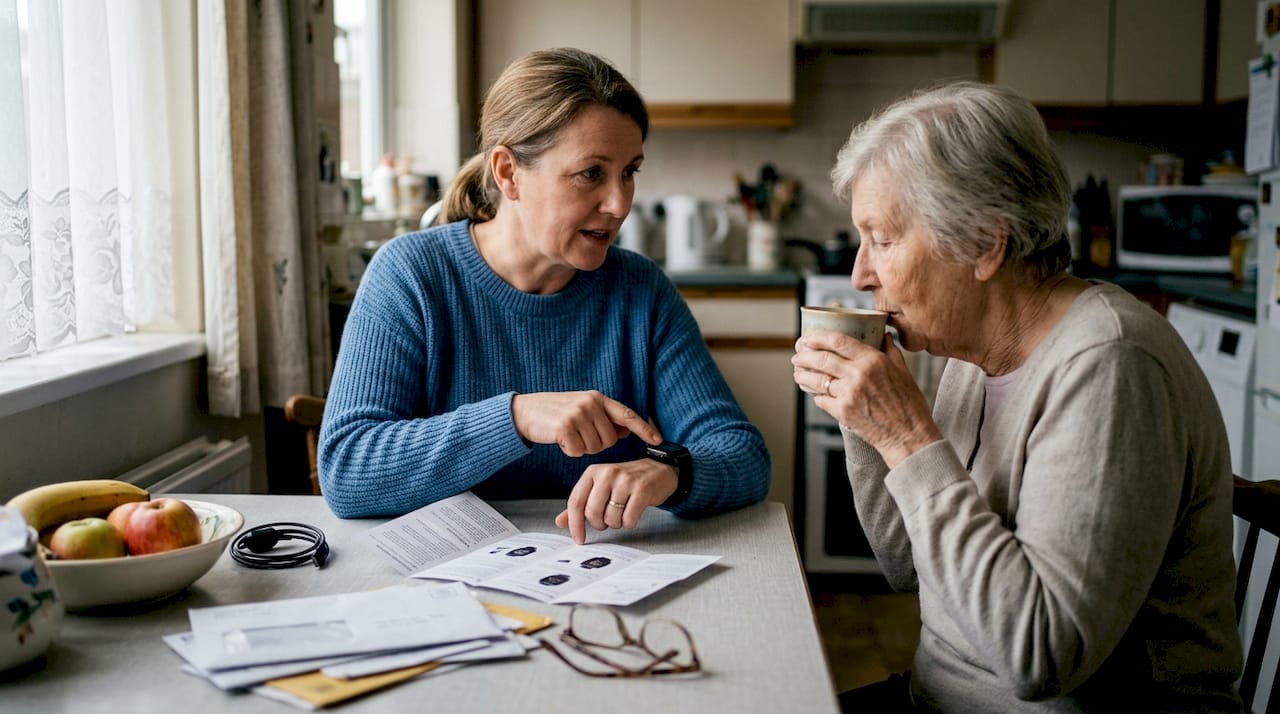
Tracking a loved one’s location is a powerful tool, but it comes with real ethical responsibilities. Seniors are adults with the right to privacy and dignity. Using a GPS watch without their knowledge or consent is not just ethically wrong. It can damage trust and create resistance to wearing the device at all.
Here is how to approach GPS tracking respectfully:
- Have an open conversation about why the watch is helpful and what it does.
- Involve the senior in setup so they feel in control, not monitored.
- Use privacy-first apps that store only what is necessary and protect health data.
- Review what data is collected and who has access to it.
GPS tracking balances safety with autonomy but raises real consent concerns. HIPAA-compliant apps are recommended when health-related data is involved, ensuring that sensitive information stays protected.
“The goal of GPS tracking is not surveillance. It is giving seniors the freedom to live independently while giving families the confidence to let them.”
When framed correctly, most seniors accept and even appreciate the watch. It gives them a way to call for help instantly and reassures them that someone is always reachable.
Explore GPS smartwatch options for enhanced senior safety
If you have made it this far, you now understand exactly what separates a basic GPS watch from a genuinely protective safety device. The SIM card is not a minor add-on. It is the feature that makes real-time monitoring, SOS alerts, geofencing, and two-way communication possible.
At KUUS, we offer GPS smartwatches and safety devices designed specifically for seniors who want to stay independent and families who want peace of mind. Our devices include SOS buttons, fall detection, live GPS tracking, and two-way calling, all without a monthly subscription. Whether you are looking for guidance on how alarm buttons support independence, want to understand why GPS smartwatches are safer than carrying a phone, or are ready to browse GPS alarm options for seniors, we have the tools and information to help you make the right choice.
Frequently asked questions
Can a GPS watch work without a SIM card?
A GPS watch can locate itself via satellite without a SIM card, but it cannot transmit that location to a caregiver’s phone or app in real time.
How much data does a GPS smartwatch SIM need?
GPS tracking uses very little data. Most users stay well under 500MB per month, even with frequent location updates throughout the day.
Are SIM-enabled GPS watches safe for privacy?
Yes, when used with the senior’s consent and a HIPAA-compliant app, SIM GPS watches can be set up to protect health data and respect personal boundaries.
Is Bluetooth-only tracking ever enough for seniors?
Bluetooth-only tracking works in short-range, supervised settings but fails outdoors and is unreliable for seniors with dementia or those who move independently.
How accurate are SIM GPS watches?
Outdoors, accuracy is typically 10 to 50 feet. Indoors, accuracy may decrease unless the watch uses WiFi positioning as a fallback.