




TL;DR:
- GPS trackers provide real-time location monitoring but lack emergency calling and fall detection features.
- SOS watches enable direct communication, automatic fall alerts, and emergency buttons for immediate help.
- Choosing between them depends on specific risks, daily routines, and the senior’s ability to manage devices.
Choosing the right safety device for an elderly loved one feels straightforward until you realize how different GPS trackers and SOS watches actually are. Many caregivers assume both devices do the same job. They don’t. Picking the wrong one can leave dangerous gaps in emergency response, especially during a fall or sudden health crisis at home. Seniors living alone deserve more than just location monitoring. They need fast, reliable communication when seconds count. This guide breaks down the core differences between GPS trackers and SOS watches, explains which scenarios each device handles best, and helps you make a confident, informed decision for your family.
Table of Contents
- What is a GPS tracker? Core features and limitations
- What is an SOS watch? Functions, benefits, and everyday use
- Side-by-side: GPS tracker vs SOS watch (comparison table)
- Which should you choose? Decision factors for caregivers
- A caregiver’s perspective: Why there’s rarely a one-size-fits-all solution
- Explore trusted GPS and SOS solutions for seniors
- Frequently asked questions
Key Takeaways
| Point | Details |
|---|---|
| GPS tracks, SOS alerts | GPS trackers help locate seniors while SOS watches offer instant emergency communication for better safety. |
| Response speed matters | SOS watches can alert caregivers within seconds, which is crucial during medical emergencies. |
| Fit device to needs | Choose the device based on your loved one’s unique risks, abilities, and habits for best results. |
| Dual solutions can help | Combining devices covers more safety needs for seniors with both wandering and medical risks. |
What is a GPS tracker? Core features and limitations
A GPS tracker is a compact device, often worn as a pendant or clipped to clothing, that continuously records and shares a senior’s location in real time. The primary purpose is straightforward: families and caregivers can open an app and instantly see where their loved one is. That single feature brings enormous peace of mind, particularly when someone tends to wander.
Here’s what a standard GPS tracker typically offers:
- Real-time location updates via a smartphone app
- Geofencing alerts that notify you when a senior leaves a designated safe zone
- Location history so caregivers can review movement patterns
- Long battery life compared to smartwatches, often lasting several days
- Compact, lightweight design that’s easy to attach to clothing or a bag
For families caring for a loved one with dementia or a tendency to wander, GPS tracker watch dementia technology has genuinely changed the game. Knowing a senior has crossed into an unsafe area triggers an immediate alert, giving caregivers time to respond before a situation becomes dangerous.
However, GPS trackers come with real limitations that caregivers often overlook. Most standalone GPS trackers do not include two-way voice calling, a dedicated SOS button, or automatic fall detection. If your loved one falls in the kitchen and cannot reach their phone, a GPS tracker will simply show their location. It will not call for help.
“GPS trackers help prevent wandering but are insufficient alone for medical emergencies.”
That gap matters. A senior who has collapsed needs more than location data. They need a way to communicate, or a device that automatically detects the fall and alerts someone. GPS-only devices aren’t built for that.
For broader GPS security for seniors, trackers work best as one layer of a larger safety plan, not as a standalone solution.
Pro Tip: If your loved one wanders frequently but is otherwise physically active and capable, a GPS tracker works well as a complementary tool. But never rely on it alone if they also face fall risk or health emergencies.
What is an SOS watch? Functions, benefits, and everyday use
An SOS watch is a wearable device, worn on the wrist like a regular watch, that combines GPS location tracking with active emergency features. The key distinction is that an SOS watch doesn’t just show where someone is. It empowers the senior themselves to call for help, and in some cases, calls for help automatically.
Core features found in quality SOS watches include:
- One-press SOS button that immediately contacts designated family members or caregivers
- Built-in GPS for real-time location sharing
- Automatic fall detection that triggers an alert without any action from the user
- Two-way voice calling directly through the watch
- Real-time notifications sent to a caregiver’s smartphone
- Simple, large-button interface designed for seniors with limited tech experience
SOS smartwatches for elderly users are specifically engineered for easy, intuitive use. The buttons are large, the screen is clear, and the setup process is simple. A senior doesn’t need tech skills to press one button and reach their family.
Consider this scenario: your mother is home alone and slips in the hallway. She cannot reach her phone. If she’s wearing an SOS watch with fall detection, the watch automatically senses the impact, sends her location to you, and triggers a voice call. You can speak directly with her through the watch to assess the situation before emergency services arrive.
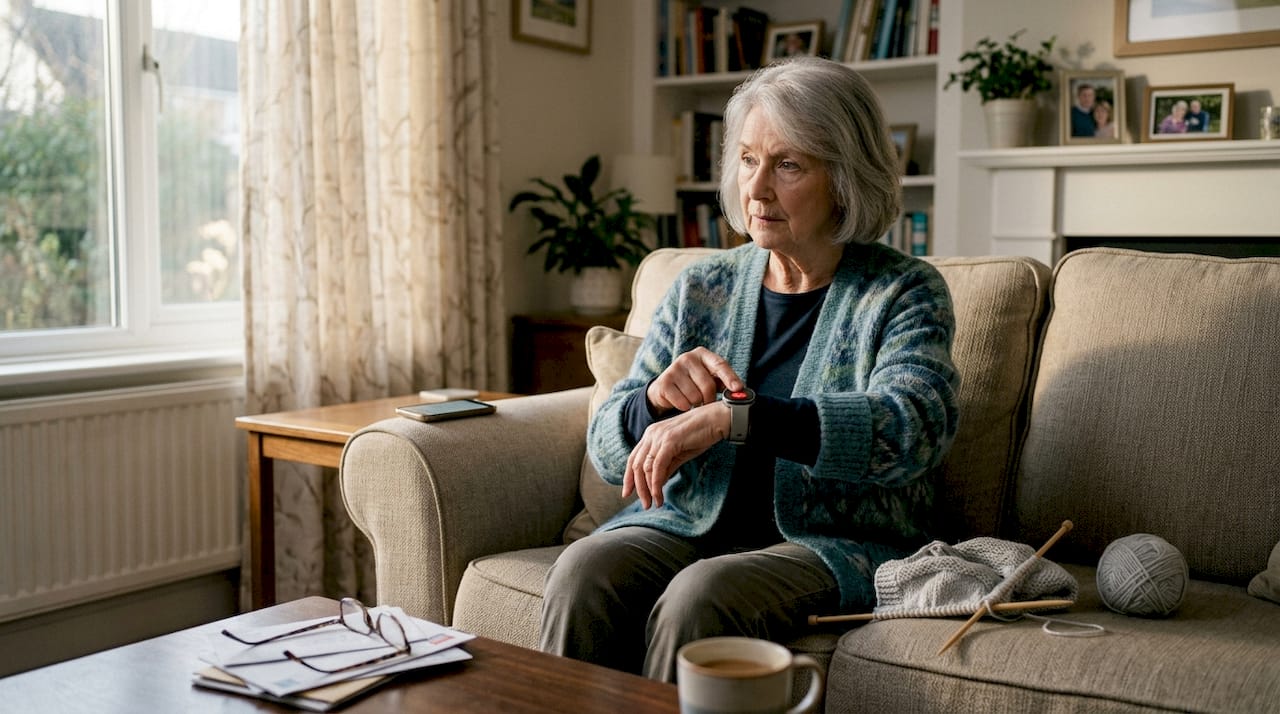
That kind of response changes outcomes. According to research on SOS watches promoting independence, fall detection and emergency buttons are key features that support independent living safely.
For a detailed comparison of available models, the best SOS watches comparison guide covers 2026’s top options clearly. You can also explore the benefits of fall alarm watches in more depth if fall risk is your primary concern.
Pro Tip: SOS watches require daily or every-other-day charging. Build charging into a consistent routine, such as overnight on the nightstand, to make sure the watch is always ready when it’s needed most.
Side-by-side: GPS tracker vs SOS watch (comparison table)
To give you a clear, at-a-glance view, let’s compare GPS trackers and SOS watches side by side.
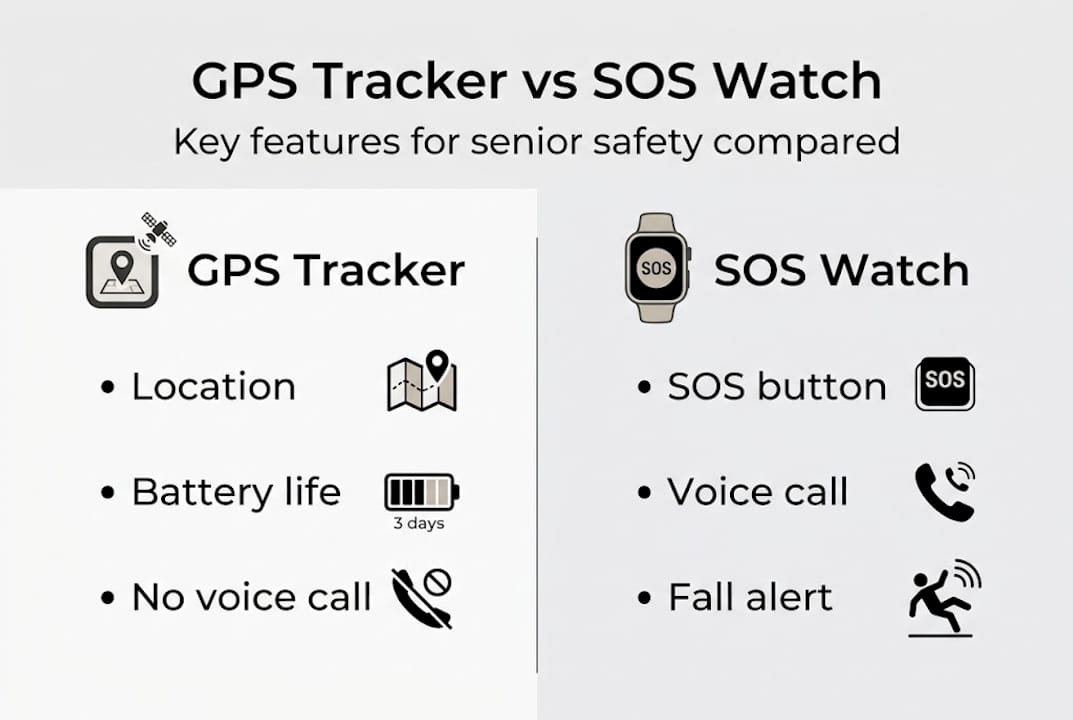
| Feature | GPS Tracker | SOS Watch |
|---|---|---|
| Real-time GPS location | Yes | Yes |
| SOS emergency button | Rarely | Yes |
| Two-way voice calling | No | Yes |
| Automatic fall detection | No | Yes |
| Geofencing alerts | Yes | Yes (most models) |
| Battery life | 3-7 days | 1-2 days |
| Wearability | Clip-on or pendant | Wrist-worn |
| Best for | Wandering prevention | Falls, emergencies, daily safety |
| Ease of use | Very easy | Easy to moderate |
The accuracy of these devices matters too. SOS smartwatch GPS accuracy benchmarks show that top models pinpoint location within 30-50 feet, with some devices like MGMove offering emergency response connections in as little as 10 seconds.
For broader context on device safety, GPS smartwatch safety data shows why wearables outperform phones in emergency situations for seniors.
Here’s a quick decision guide based on common scenarios:
- Senior wanders due to dementia: GPS tracker is effective; add SOS watch for complete coverage
- Senior lives alone with fall risk: SOS watch is the better primary choice
- Senior needs two-way communication: SOS watch only
- Caregiver needs passive location monitoring: GPS tracker or SOS watch both work
- Senior has limited dexterity or memory: GPS tracker requires less daily management
Reviewing essential features for alarm watches can help you prioritize what matters most for your specific situation.
Which should you choose? Decision factors for caregivers
With the facts laid out, it’s time to apply them to your family’s real-world situation. The right choice depends on your loved one’s specific risks, lifestyle, and cognitive ability.
Follow these steps to map needs to the right device:
- Identify the primary risk. Is it wandering, falling, or both? Wandering leans toward GPS tracking. Falls and emergencies lean toward SOS watches.
- Assess cognitive and physical ability. Can your loved one press a button reliably? If not, automatic fall detection becomes critical.
- Consider daily routine. Will they wear the device consistently? Wrist-worn watches tend to stay on more reliably than clip-on trackers.
- Evaluate caregiver availability. How quickly can someone respond? An SOS watch with two-way voice buys critical time.
- Think about charging habits. A device that runs out of power offers no protection.
| User profile | Recommended device |
|---|---|
| Dementia with wandering risk | GPS tracker (primary), SOS watch (secondary) |
| Senior living alone, fall risk | SOS watch |
| Active senior, mild memory issues | SOS watch with GPS |
| Highly independent senior | SOS watch for emergencies |
| Senior who forgets to charge devices | GPS tracker (longer battery) |
It’s worth noting that some GPS trackers add SOS buttons but often lack two-way voice and require less frequent charging, while SOS watches need regular charging and suit those able to use them reliably.
Understanding how GPS alerts help caregivers respond faster is also worth exploring if you’re building a broader care plan. And if cost justification matters to you, the value of a GPS watch for elders article addresses that directly.
Pro Tip: For seniors with complex needs, combining a GPS tracker for passive location monitoring with an SOS watch for active emergency response gives you the strongest safety net without over-complicating daily life.
A caregiver’s perspective: Why there’s rarely a one-size-fits-all solution
Most guides reduce this decision to a feature checklist. The reality is messier. Caregiving involves personalities, habits, and emotional dynamics that no comparison table captures.
A senior who resents wearing a device won’t use it consistently, no matter how many features it has. A family that checks the app once a week isn’t truly benefiting from real-time GPS. Technology only works when it fits into real life.
The honest truth is that device choice should evolve over time. What works for a mildly forgetful 75-year-old may not work two years later. Revisiting the decision annually, or after any significant health change, matters more than getting it perfectly right the first time.
We also see caregivers underestimate simple, low-tech solutions alongside devices. A consistent daily check-in call combined with an SOS watch often outperforms a complicated multi-device setup that overwhelms the user.
Exploring the real benefits of fall alarm watches from a practical, everyday perspective helps ground these decisions in lived experience rather than spec sheets alone.
Explore trusted GPS and SOS solutions for seniors
When you’re ready to take action, we’ve rounded up reliable resources to help you find the perfect senior safety device. Finding a solution that genuinely fits your loved one’s needs doesn’t have to be overwhelming.
Whether you’re looking for a simple alarm button with GPS for a parent who lives alone, or a full-featured watch with fall detection for a higher-risk senior, trusted options exist for every situation. Browse our curated selection of alarm watches for seniors to compare devices side by side with clear, honest descriptions. If you want a structured overview before deciding, the compare best SOS watches for elderly guide is a great starting point. Our team is also available to answer your specific questions and help you find what truly fits.
Frequently asked questions
Can a GPS tracker be used as an emergency alert device?
Most GPS trackers do not include two-way voice or a dedicated SOS button, which limits their use in real emergencies. Some GPS trackers add SOS capabilities, but without two-way voice, they remain insufficient for medical emergencies.
How accurate are SOS watches and GPS trackers for seniors?
Top SOS smartwatches achieve location accuracy within 30-50 feet, and the fastest models connect emergency responses in as little as 10 seconds. The MGMove 10-second response benchmark sets the current industry standard for senior safety wearables.
Which is best for seniors with dementia: GPS tracker or SOS watch?
A GPS tracker covers wandering prevention effectively, but an SOS watch adds fall detection and direct communication, making it the stronger daily safety tool. GPS trackers for wandering prevention are best used alongside an SOS watch for full coverage.
What are the main drawbacks of SOS watches?
SOS watches need charging every one to two days, and seniors who forget routines may leave them unpowered when needed most. SOS watches require frequent charging and may not suit users who struggle with consistent device management.