




TL;DR:
- GPS accuracy varies by environment, typically 3-10 meters outdoors but much less indoors.
- Factors like obstructions and satellite signals influence real-world location precision.
- Regular testing in actual environments ensures reliable tracking for senior safety.
Many families assume a GPS tracker always shows exactly where their loved one is standing. That belief feels reassuring, but it does not always reflect reality. Signal conditions, device type, and surroundings all shape how precise a location reading actually is. Knowing what drives GPS accuracy helps you choose the right device, set realistic expectations, and respond faster when a senior needs help. This guide walks through what accuracy means, what affects it, and how to apply that knowledge to keep elderly loved ones safer every day.
Table of Contents
- What does GPS accuracy mean?
- How GPS devices find locations: satellites, signals, and device types
- What affects GPS accuracy? Real-world challenges for caregivers
- Practical use: How much accuracy do you really need for senior safety?
- Our perspective: Most accuracy concerns are solved by the right setup and regular testing
- Ready to boost senior safety? Discover reliable GPS solutions
- Frequently asked questions
Key Takeaways
| Point | Details |
|---|---|
| GPS accuracy varies | Consumer devices typically range from 3 to 10 meters outdoors, with less accuracy indoors. |
| Environment is crucial | Buildings, trees, and weather affect GPS reliability more than device specifications alone. |
| Hybrid tracking helps | Devices that use WiFi or cellular backup perform better in challenging or indoor locations. |
| Test in real-life settings | Always check how a tracker works in the actual locations your loved one frequents. |
What does GPS accuracy mean?
GPS accuracy is simply the difference between where a device says someone is and where they actually are. A smaller gap means better accuracy. A larger gap means the location shown on your screen could be off by a meaningful distance.
Most consumer devices show accuracy in meters. A reading of ±5 meters means the estimated position is within 5 meters of the true location. That sounds precise, and outdoors in open space, it often is. Consumer GPS devices typically achieve 3–10 meter accuracy in open sky conditions, but that number can degrade to 10–50 meters or more in urban or obstructed environments.
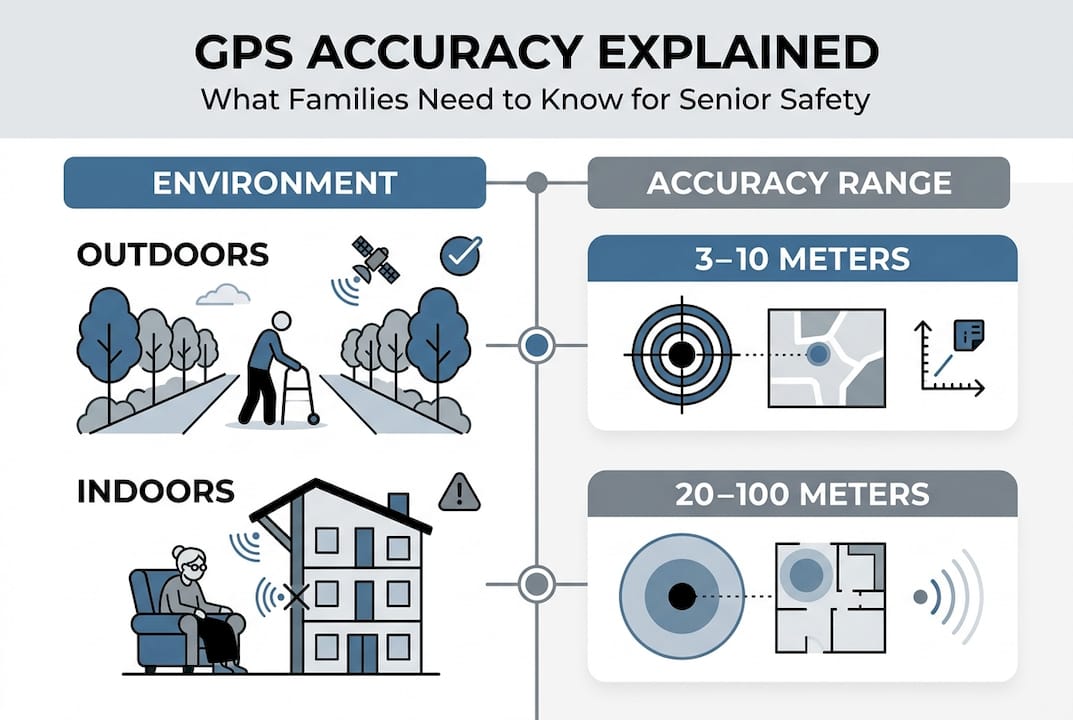
For families caring for a senior, this distinction matters a great deal. A 5-meter error in a park is negligible. A 50-meter error in a dense city neighborhood could mean the difference between spotting your loved one quickly or searching the wrong block.
Here is a quick comparison of typical GPS accuracy across environments:
| Environment | Typical accuracy range |
|---|---|
| Open outdoor area | 3–10 meters |
| Suburban streets | 5–20 meters |
| Dense urban area | 10–50+ meters |
| Indoors (GPS only) | 50–100+ meters |
| Indoors (WiFi/cellular fallback) | 15–100 meters |
For everyday senior safety, real-world tests show 10–30 meter accuracy is generally sufficient. If a caregiver can get within a 30-meter radius of where a senior is, they can find that person quickly, especially with a two-way call feature to confirm exact position.
Key accuracy facts worth remembering:
- GPS accuracy is measured in meters, not dots on a map
- Outdoors in clear conditions, most devices are reliable within 3–10 meters
- Urban environments can push error to 50 meters or beyond
- Indoors, GPS alone becomes far less dependable
- A device’s reported accuracy is an estimate, not a guarantee
Understanding GPS security for the elderly starts with accepting that no system is perfectly precise, but good enough accuracy is very achievable with the right device. Choosing solutions designed for seniors, like those covered in this guide on GPS tracker accuracy for seniors, helps narrow the gap between expectation and reality.
How GPS devices find locations: satellites, signals, and device types
GPS devices find your location through a process called trilateration. The device receives signals from multiple satellites orbiting Earth and uses the time each signal takes to arrive to calculate distance. With distances from at least four satellites known, it can pinpoint a position in three dimensions.
GPS accuracy is determined by trilateration using four or more satellites, and adding more satellites in view improves precision. This is why open-sky environments produce better results: more satellites can be seen without obstruction.
Modern trackers often go beyond standard GPS by using multi-GNSS technology. GNSS stands for Global Navigation Satellite System and includes networks like GLONASS (Russia), Galileo (Europe), and BeiDou (China) alongside the American GPS system. A device that connects to multiple networks sees more satellites at once, which significantly improves reliability, especially in areas where buildings block part of the sky.
- Standard GPS only: connects to U.S. satellites, reliable outdoors
- GPS + GLONASS: adds Russian satellites, better in northern latitudes and dense areas
- GPS + GLONASS + Galileo: broadest coverage, most reliable in challenging environments
- GPS + WiFi/cellular (hybrid): uses network signals as backup when satellite signals are weak
- GPS + LBS (location-based services): lowest precision but useful when all else fails indoors
For seniors, hybrid systems that combine GPS with WiFi or cellular fallback offer the best practical coverage. If the GPS signal weakens inside a building, the device switches to nearby WiFi networks or cell towers to estimate position. The accuracy drops, but a rough location is far better than none.
One important distinction: professional survey GNSS devices achieve centimeter-level accuracy using RTK technology, but consumer-grade trackers for elderly care do not use this. They do not need to. For finding a senior in a neighborhood or park, meter-level accuracy is more than adequate.
Pro Tip: When shopping for a senior GPS tracker, look for devices that list multi-GNSS and SBAS support on their spec sheet. SBAS (Satellite-Based Augmentation System) uses ground stations to correct signal errors and can push outdoor accuracy below 5 meters. This level of reliability makes a real difference for everyday tracking for senior safety.
What affects GPS accuracy? Real-world challenges for caregivers
Even the best GPS device performs differently depending on where it is being used. Several real-world factors shape how accurate a reading will be at any given moment.
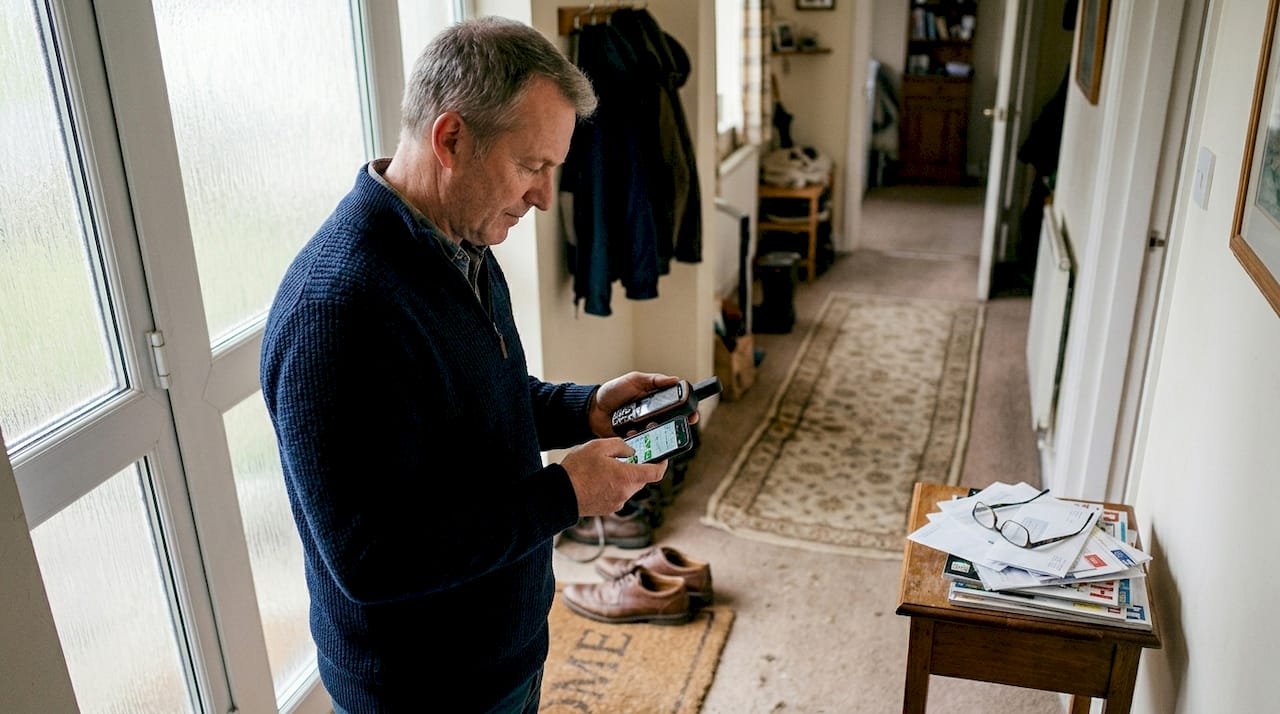
Key error sources include satellite geometry, atmospheric delays, multipath reflections, signal obstructions, and receiver quality. Each one can add or subtract meters from the reported position.
Here is a breakdown of the most relevant factors for caregivers:
- Satellite geometry (DOP): If visible satellites are clustered on one side of the sky rather than spread out, position calculations become less reliable. More spread means better geometry and better accuracy.
- Atmospheric delays: GPS signals pass through the ionosphere and troposphere, where they slow slightly. This adds a small but measurable error. Dual-frequency receivers can cut this error significantly.
- Multipath reflections: Signals bouncing off buildings, cars, or walls arrive at the device from multiple directions and confuse the receiver. Urban areas with tall buildings create the worst multipath conditions.
- Signal obstructions: Trees, rooftops, walls, and tunnels can block satellite signals entirely. Dense foliage in summer can reduce accuracy noticeably compared to winter.
- Receiver quality: A higher-quality chip in the tracking device filters out noise and processes signals faster, resulting in more stable readings.
Multipath errors in urban environments can be 3 to 5 times worse than in open areas. Dual-frequency receivers can cut ionospheric error by up to 90%, but most consumer trackers use single-frequency chips.
Indoor and urban fallback to WiFi and LBS can introduce 100 meters or more of error, while WAAS/SBAS correction outdoors can bring accuracy below 5 meters. Knowing this helps caregivers interpret a location ping correctly. If the app shows a senior inside a building, the actual error margin is much wider than it would be outside.
This has direct implications for GPS tracker use in care environments such as care homes or assisted living facilities with thick walls. And for seniors who move between indoor and outdoor settings frequently, GPS alert reliability for seniors depends on understanding these shifts.
Pro Tip: Always test the device in the actual environments your loved one frequents, including their home, yard, local park, and any regular destinations. A quick walk-around test tells you more than any spec sheet.
Practical use: How much accuracy do you really need for senior safety?
Spec sheets can be misleading. A device advertised with “1-meter accuracy” may never achieve that in the places your loved one actually goes. The more useful question is: what level of accuracy is genuinely enough to keep a senior safe?
Real-world tests show 10–30 meter accuracy is sufficient for safety, while 1–10 meters is ideal for wandering prevention in seniors with dementia or disorientation. Most well-designed consumer trackers fall comfortably in the useful range outdoors.
For reference, Garmin’s GPSMAP 67 achieves roughly 3 meters with WAAS correction, while typical consumer trackers land between 10 and 100 feet in real-world conditions depending on environment.
Here is how to test a GPS tracker in your loved one’s actual life:
- Bring the device to the senior’s home and check the reported location on a map against a known address
- Walk to the front yard and backyard, then check accuracy in each location
- Visit a local park or outdoor area and compare where the app shows you versus your real position
- Enter a grocery store or community center and note how quickly and accurately the position updates
- Record the difference in meters at each location and use that as your real-world benchmark
| GPS tracker feature | Why it matters for seniors |
|---|---|
| Multi-GNSS support | More satellites, more reliable location in any area |
| SBAS/WAAS correction | Better outdoor accuracy, often below 5 meters |
| WiFi/cellular fallback | Location even when GPS signal is blocked indoors |
| SOS alert with location share | Sends position instantly when senior presses the alarm |
| Geofencing alerts | Notifies caregivers if senior leaves a defined safe zone |
| Two-way call | Lets caregiver confirm exact position by speaking directly |
Pro Tip: Rather than relying on advertised specs alone, always run real tests in the places your family member spends time. A device that performs well in those specific spots is worth far more than one with impressive numbers on paper.
For families comparing options, guides on best family GPS solutions and the senior tracker checklist offer practical frameworks for making the right choice.
Our perspective: Most accuracy concerns are solved by the right setup and regular testing
After working with families who protect elderly loved ones every day, we have seen a common pattern. Caregivers spend weeks comparing GPS accuracy numbers online, then buy a device based on specs, only to find it underperforms in their parent’s apartment building or neighborhood.
Chasing the most precise GPS number on paper misses the point. Environments change constantly. Technology has real limits. What matters far more is choosing a device suited to where your loved one actually spends time, then testing it there before you rely on it.
Environment matters more than device specs for actual accuracy.
Hybrid systems that combine GPS with WiFi and cellular backup cover the gaps that pure GPS cannot. Alert settings, geofencing, and the SOS button fill in where precision ends. These features, paired with a two-way call, mean a caregiver can find someone even when the location pin is off by 20 meters.
We believe regular real-world checks beat any advertised figure. A tracker tested monthly in familiar environments gives caregivers genuine confidence. For a broader look at why these wearables work so well, the benefits of GPS smartwatch advantages over phones show exactly why the right form factor matters as much as the signal itself.
Ready to boost senior safety? Discover reliable GPS solutions
Understanding GPS accuracy is the first step. Acting on that knowledge is what keeps your loved one safe. At Kuus, we offer a range of wearable safety devices built specifically for seniors, including GPS watches, alarm watches with SOS buttons, and personal alarm solutions, all without monthly subscription costs.
Whether you need a GPS alarm button for elderly users who want one-press emergency contact, or want to explore personal alarm solutions for seniors designed for daily independence, we have options matched to real-life needs. You can also learn more about the value of a GPS watch for seniors to see how these tools fit into everyday routines. Start with a solution that matches your loved one’s environment and habits.
Frequently asked questions
How accurate are GPS devices for tracking seniors outdoors?
Most consumer GPS devices achieve 3–10 meter accuracy outdoors in open sky conditions, which is more than sufficient for locating a senior quickly and safely.
Why does GPS accuracy drop inside buildings or cities?
Signals bounce off walls and tall structures, a problem called multipath, causing accuracy to degrade to 10–50+ meters or more in urban or indoor environments where satellite visibility is limited.
Can GPS trackers prevent seniors from wandering?
Accuracy of 1–10 meters is ideal for wandering prevention, allowing caregivers to respond fast and locate a disoriented senior before they move far from a safe zone.
Does using more satellites or hybrid tracking really help?
Yes. Multi-GNSS improves reliability by increasing the number of visible satellites, and adding WiFi or cellular fallback ensures a location estimate is still available when GPS signals are blocked.
How can I test a GPS tracker’s accuracy for my family member?
Take the device to each place your loved one regularly visits, check the reported location against a known address or landmark, and note the margin of difference both outdoors and indoors.