




TL;DR:
- GPS tracking provides accurate, global outdoor location data independent of WiFi networks.
- WiFi tracking is suitable mainly for indoor or stationary monitoring within known access point zones.
- For outdoor safety and real-time emergencies, GPS trackers ensure reliability and peace of mind.
Many families assume that a WiFi-based tracking app is enough to keep a senior loved one safe. That assumption feels reasonable until a parent with early-stage dementia walks out the front door and leaves the home network behind. At that point, WiFi tracking stops working, and real-time visibility disappears. GPS, by contrast, maintains accurate location data outdoors, independently of any local network. This guide breaks down how each technology actually performs, what the evidence says about accuracy and reliability, and how to make a confident, informed choice for the person you care about most.
Table of Contents
- Understanding GPS and WiFi tracking: How do they work?
- Accuracy and reliability: Why outdoor tracking matters most
- Limitations and power considerations: The full picture
- Application in senior care: Choosing the best fit for your loved one
- Our perspective: What most articles miss about senior tracking safety
- Explore trusted GPS safety solutions for seniors
- Frequently asked questions
Key Takeaways
| Point | Details |
|---|---|
| GPS leads in accuracy | GPS trackers provide far better outdoor accuracy than WiFi, ideal for finding seniors quickly. |
| Coverage matters most | GPS works globally even when WiFi isn’t available, offering peace of mind for caregivers. |
| Real-time alerts save lives | GPS trackers offer rapid location updates and geofencing to help families respond before wandering becomes dangerous. |
| Practicality over theory | Minor battery tradeoffs are worth the reliability GPS brings for senior independence and safety. |
Understanding GPS and WiFi tracking: How do they work?
Before comparing the two, it helps to understand what each technology actually does. GPS (Global Positioning System) uses signals from a network of satellites orbiting the earth. A GPS device receives signals from multiple satellites simultaneously and calculates its exact position based on signal timing. This process works anywhere under open sky, regardless of whether there is a cellular tower, router, or internet connection nearby.
WiFi tracking works differently. It uses the signal strength of nearby wireless access points to estimate a device’s location. The device does not need to connect to those networks. It simply detects them and cross-references their known positions in a database. This method is called WiFi triangulation. It works reasonably well indoors where access points are dense, but breaks down quickly in open outdoor environments where few or no WiFi signals are present.
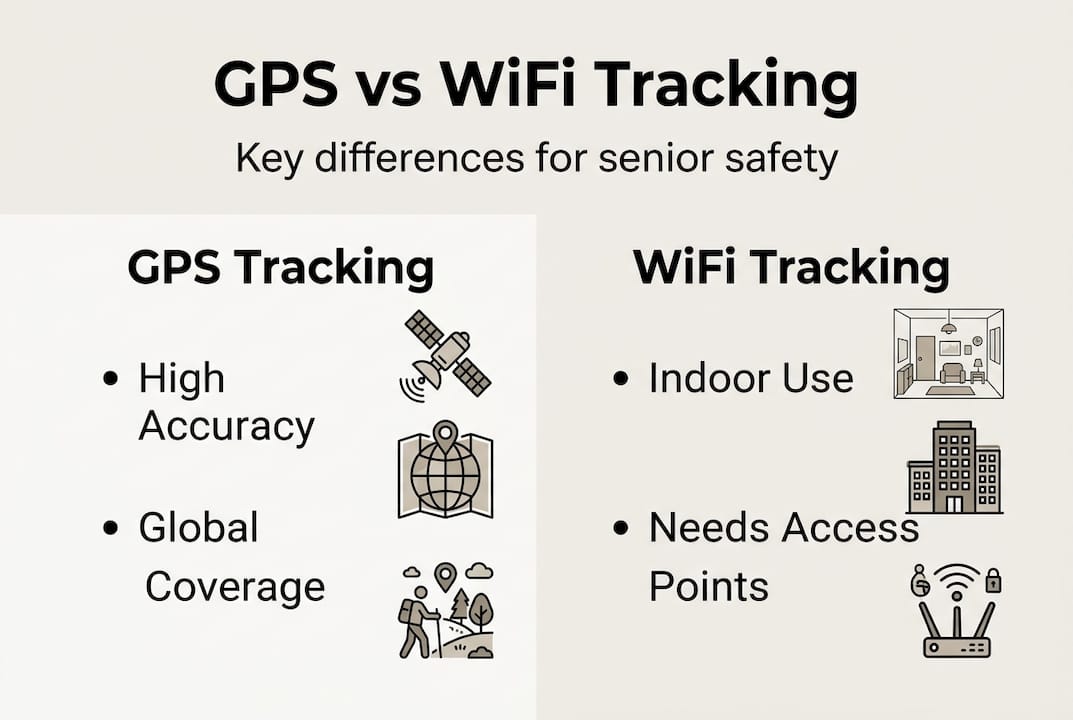
For everyday senior safety, the practical difference is significant. Consider this comparison:
| Feature | GPS tracking | WiFi tracking |
|---|---|---|
| Outdoor accuracy | 2-5 meters | 10-20 meters |
| Works without local network | Yes | No |
| Real-time outdoor updates | Yes | Limited |
| Best environment | Open outdoor areas | Indoor, urban |
| Typical use for seniors | Wandering, walks, errands | Home monitoring |
When a senior takes a walk around the block or visits an unfamiliar neighborhood, GPS tracking for seniors provides a live, accurate picture of where they are. WiFi tracking may show nothing at all once they step outside a familiar coverage zone.
Key differences at a glance:
- GPS works globally, outdoors, independent of local infrastructure
- WiFi depends entirely on known access points being nearby
- GPS outdoor accuracy is 2-5 meters versus 10-20 meters for WiFi triangulation
- WiFi is well suited for stationary monitoring at home, not for mobile seniors
Pro Tip: Some devices combine GPS with WiFi to improve indoor accuracy when GPS signals are weak. That hybrid approach adds value, but for outdoor emergencies, GPS is the technology that truly counts.
Accuracy and reliability: Why outdoor tracking matters most
Accuracy is not just a technical specification. For caregivers, it is the difference between finding a loved one quickly and spending anxious minutes searching the wrong street. When a senior with dementia wanders outdoors, every meter of error and every minute of delay matters.
Research confirms the performance gap. GPS offers global coverage independent of local infrastructure, meaning it works in parks, rural roads, shopping districts, and unfamiliar neighborhoods where WiFi access points simply do not exist. WiFi tracking, however accurate it may be inside a known home or facility, becomes unreliable the moment a senior moves beyond that space.
Here is a side-by-side comparison of real-world performance:
| Metric | GPS | WiFi |
|---|---|---|
| Outdoor location accuracy | 2-5 meters | 10-20 meters |
| Coverage area | Global | Local access point zones |
| Works in rural areas | Yes | Rarely |
| Real-time updates | Yes | Partial, indoors only |
| Geofencing alert support | Yes | Limited |
Geofencing is particularly important for dementia care. GPS trackers enable geofencing alerts that notify caregivers the moment a senior crosses a defined boundary, allowing rapid response before a situation escalates. WiFi systems typically cannot replicate this in outdoor environments.
“Knowing the exact location of a wandering senior within seconds is not a luxury. It is the foundation of an effective emergency response.”
For families helping a loved one maximize independence while managing genuine safety risks, GPS delivers where it matters most. And for those specifically caring for someone with memory loss, a GPS tracker watch for dementia provides the reliable outdoor visibility that WiFi simply cannot offer.
Top reasons GPS wins for family peace of mind:
- Accurate to within 2-5 meters, even far from home
- Operates independently of any WiFi network or hotspot
- Supports real-time geofencing alerts for wandering detection
- Reliable in rural, suburban, and unfamiliar urban locations
- Gives caregivers confidence to allow more independence
Limitations and power considerations: The full picture
No technology is perfect, and GPS tracking does come with trade-offs. The most important one is power consumption. GPS modules draw more current than WiFi chips, typically around 20-30mA for GPS versus significantly less for WiFi-only operation. However, modern GPS tracking devices designed for seniors have improved substantially. Most now offer 5-10 day battery life on a single charge, making daily or every-other-day charging a simple routine.
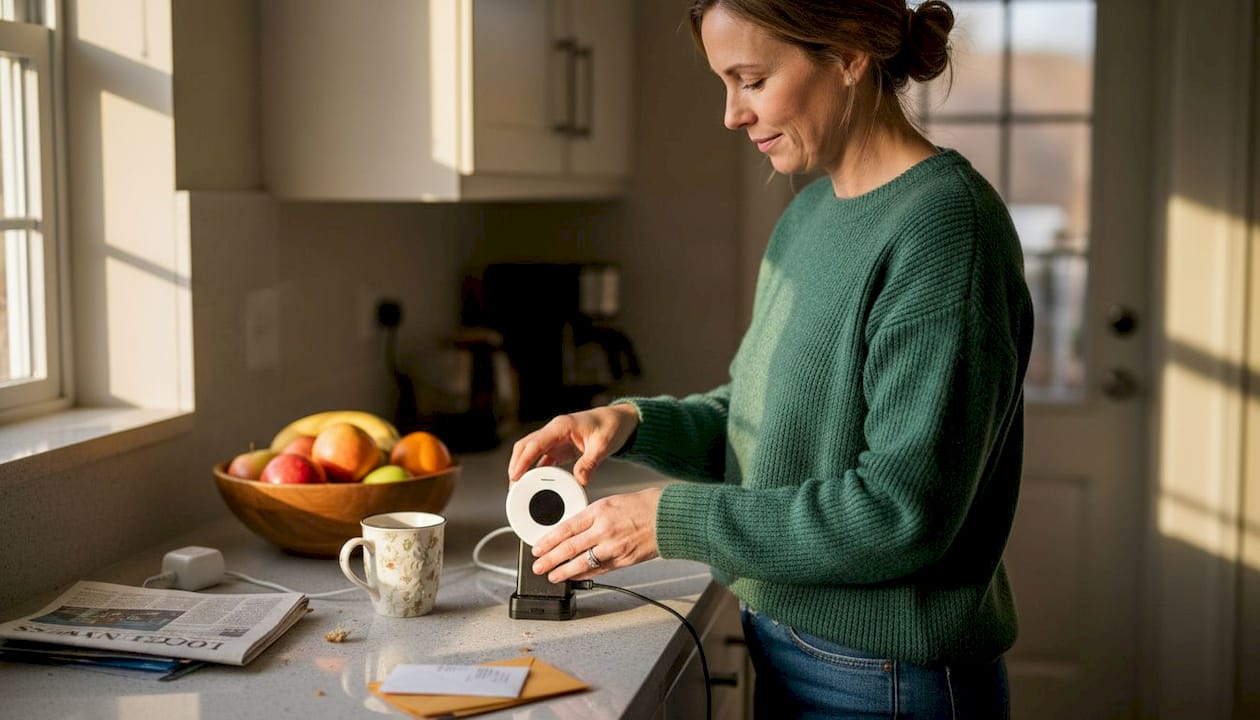
WiFi-based devices do consume less power, which sounds appealing. But lower power consumption only matters if the device is delivering useful data. A tracker that runs for weeks but loses location the moment a senior leaves the house provides limited practical value for caregivers managing real outdoor risk.
Here is a practical maintenance checklist for caregivers managing a GPS tracker:
- Set a consistent daily charging schedule, such as overnight while the senior sleeps
- Check battery level each morning before the senior begins their day
- Enable low-battery push notifications through the companion app
- Keep a backup charging cable accessible at home and at a caregiver’s location
- Test the SOS button and location accuracy weekly to confirm the device is functioning correctly
- Update the device’s app and firmware regularly to maintain performance
For families monitoring seniors remotely, these small habits build a reliable safety routine that does not feel burdensome over time.
Pro Tip: Match the charging routine to an existing daily habit, such as bedtime or morning coffee. Seniors are more likely to keep devices charged when it feels like a natural part of their day rather than an extra task.
It is also worth noting that GPS tracking devices work best when paired with a cellular SIM card. This is what transmits location data to the caregiver’s app in real time. Without an active SIM, GPS coordinates cannot be sent remotely. Most modern senior GPS watches use a standard 4G SIM, and many are designed to work without an ongoing subscription.
Application in senior care: Choosing the best fit for your loved one
With a clear understanding of how both technologies perform, the decision becomes much more practical. The right choice depends on your loved one’s daily habits, level of independence, and specific risk factors.
Hybrid devices use GPS as primary with WiFi and cellular as fallback layers. This is a smart architecture for environments where GPS signals may occasionally be weak, such as dense urban cores or shopping malls. But for seniors who primarily face outdoor wandering risk, pure GPS remains the most dependable primary solution.
Scenarios to guide your decision:
- Senior with dementia who wanders outdoors: Prioritize GPS with geofencing alerts. Real-time outdoor accuracy is non-negotiable.
- Senior who primarily stays home with occasional outings: A hybrid device offers indoor comfort and outdoor reliability.
- Senior in a rural or suburban setting: GPS is the clear choice. WiFi access points are too sparse to offer meaningful coverage.
- Urban senior with frequent indoor activity: Hybrid tracking may add indoor precision, but GPS must remain the primary mode.
“For caregivers managing wandering risk, the most critical feature is not the most advanced tech. It is consistent, reliable outdoor location data that is available when you need it most.”
Practical GPS alerts for caregivers make all the difference in emergencies. A notification the moment a senior crosses a geofence boundary gives you time to respond before a situation becomes dangerous. When evaluating options, look for the best GPS tracker for seniors that combines outdoor reliability with features like SOS buttons, fall detection, and two-way calling.
Our perspective: What most articles miss about senior tracking safety
Most articles focus on specs and features. Very few talk about what caregivers actually feel when they realize their loved one’s device stopped working outside the WiFi zone. That moment of sudden uncertainty is something no comparison chart captures.
We believe the most overlooked factor in choosing a tracking solution is emotional reliability. Not just whether the device can locate someone, but whether you can trust it to work the moment you need it. That trust is built over time through consistent, real-world performance. GPS trackers reduce caregiver stress and have been shown to delay the need for institutional care by enabling effective real-time tracking that keeps seniors safely independent longer.
WiFi tracking feels sufficient until it is not. And in senior care, “not sufficient” happens outside, in unfamiliar places, in moments of genuine urgency. For families considering smartwatches for senior safety, prioritize outdoor reliability above all else. The best device is one that works when and where it matters, not just in the comfort of a familiar home network.
Pro Tip: Always test any GPS or tracking device outdoors, away from home WiFi, before relying on it for daily caregiving. Real-world conditions reveal what spec sheets cannot.
Explore trusted GPS safety solutions for seniors
Understanding the technology is the first step. Taking action is what truly protects your loved one. Whether you are caring for a parent living independently or managing early-stage dementia, the right GPS solution can bring meaningful peace of mind.
Our range of wearable safety devices is designed with seniors and caregivers in mind. From a reliable smartwatch for the elderly with built-in GPS and SOS functionality, to a compact GPS alarm button for seniors that fits any routine, you will find options that are simple to use and built for real-world safety. All devices work with a standard SIM card for GPS devices, and many require no monthly subscription.
Frequently asked questions
Is GPS tracking always better than WiFi for senior safety?
For outdoor tracking and rapid response to wandering, GPS is more reliable and accurate than WiFi. GPS outdoor accuracy reaches 2-5 meters compared to WiFi’s 10-20 meters, making GPS the stronger choice when it matters most.
Can WiFi tracking still help indoors or in familiar places?
WiFi tracking offers decent indoor accuracy where access points are present, but it fails as soon as a senior moves outside the coverage zone. WiFi is better suited for stationary home monitoring than for independent seniors who move through different environments.
How do battery life and charging routines compare for GPS and WiFi trackers?
Modern GPS trackers typically deliver 5-10 day battery life despite higher power consumption, making them practical for daily senior routines. WiFi uses less power but provides far less outdoor utility for active seniors.
What is the main benefit of hybrid GPS-WiFi trackers?
Hybrid devices use GPS as the primary mode with WiFi and cellular as fallback layers, offering more consistent coverage across both indoor and outdoor environments. For most caregivers, this approach provides the most complete safety solution.